
Robots optimize Cérélia's packing process
Michael Driessen
Cérélia
Project Engineer
Cérélia
Project Engineer






Founded in 1972, Higgins Premium Pet Foods began as a modest family-run pet store. The company’s roots were established by current General Manager Andy Perry’s father, who started the business by hand-blending seed mixes for birds and small animals.
Over the decades, Higgins evolved. After moving to a high-volume processing plant in Miami, the company transitioned from basic seed blending to high-end, premium nutrition.
"We started to carve out a niche for ourselves in high-quality, premium products. That's what started separating us from the competitors," says Andy Perry.
Today, Higgins is known for its gourmet blends featuring dehydrated fruits, nuts, and nitrogen-flushed packaging to ensure maximum freshness. Following its acquisition by the Dutch company Versele-Laga in 2018, the business experienced a new surge in growth.
Soon, it was evident that Higgins had to make a fundamental transition from manual processes to high-speed secondary packaging automation to meet nationwide demand.
Company: Higgins Premium Pet Foods (a Versele-Laga company).
Location: Miami, Florida.
The Challenge: A surge in labor costs and a production bottleneck where mixing (12 tons/hr) far outpaced manual packing (6 tons/hr).
The Solution: BPA CubeMaster 200
Key Results:
As Higgins Premium Pet Foods grew, its manual packaging processes began to buckle under the weight of increased demand and a volatile labor market. The company was selling high-end nutrition with premium packaging for small birds and animals viewed as family members. It needed to ensure its line could handle the increased output and packaging demands. And it needed to stop the disruptions caused by a challenging labor market.
Post-2020, the operational landscape shifted overnight. While the business stayed open to serve its customers, the local competition created a talent war that made manual labor unsustainable. It also faced challenges with manual packing itself.
The decision to automate became more a matter of financial survival rather than just speed alone. The rising cost of manual labor and its inherent efficiencies provided a clear, undeniable business case for a capital investment in secondary packaging.
To close the gap between their high-speed mixing capacity and their lagging manual pack-off, Higgins partnered with BluePrint Automation (BPA). The objective was to synchronize a 12-ton-per-hour production output with a secondary packaging system that could handle the complexity of premium, flat-bottom pouches.
"I had a mixing capacity of 10 to 12 tons an hour, but I could only pack four to six tons by hand," says Perry. "We had to match our packaging to our production output. Other robotic systems looked too complex, but the BluePrint system just made sense for how our bags needed to be presented in the box."
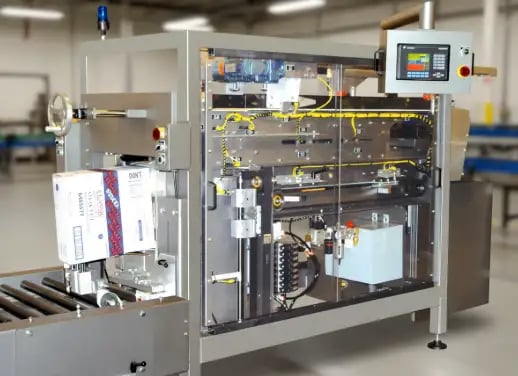
BPA identified the CubeMaster 200 as the ideal solution. While traditionally used for frozen fries in high-speed packing applications, the CubeMaster’s specialized vertical-only packing capabilities matched Higgins’ specific need for bags to stand upright in the case. The solution offered additional benefits that aligned with Higgins’ production goals:
The implementation of the CubeMaster 200 has fundamentally transformed the Higgins production floor to a streamlined automated operation.
Despite initial internal skepticism regarding the headcount required, the automation allowed Higgins to transition from a four-person packing crew to a single-operator system.
The precision of the CubeMaster 200 has opened up new logistical opportunities. Higgins is now evaluating paths to further increase profitability by optimizing their packaging dimensions.
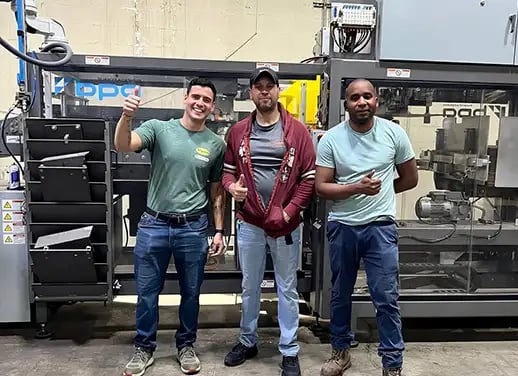
With the secondary packaging obstacle resolved, Higgins is now reinvesting in the front end of their plant, including new automated pouch fillers for 3 lb to 8 lb bags. The CubeMaster 200 was built with enough overhead capacity to handle these future increases in production without requiring additional equipment.
"The future looks bright for us," Perry concludes. "The machine itself has given us the room to implement even more output. We're automating more of our plant now to match that capacity, and we know our packaging line can handle it."